

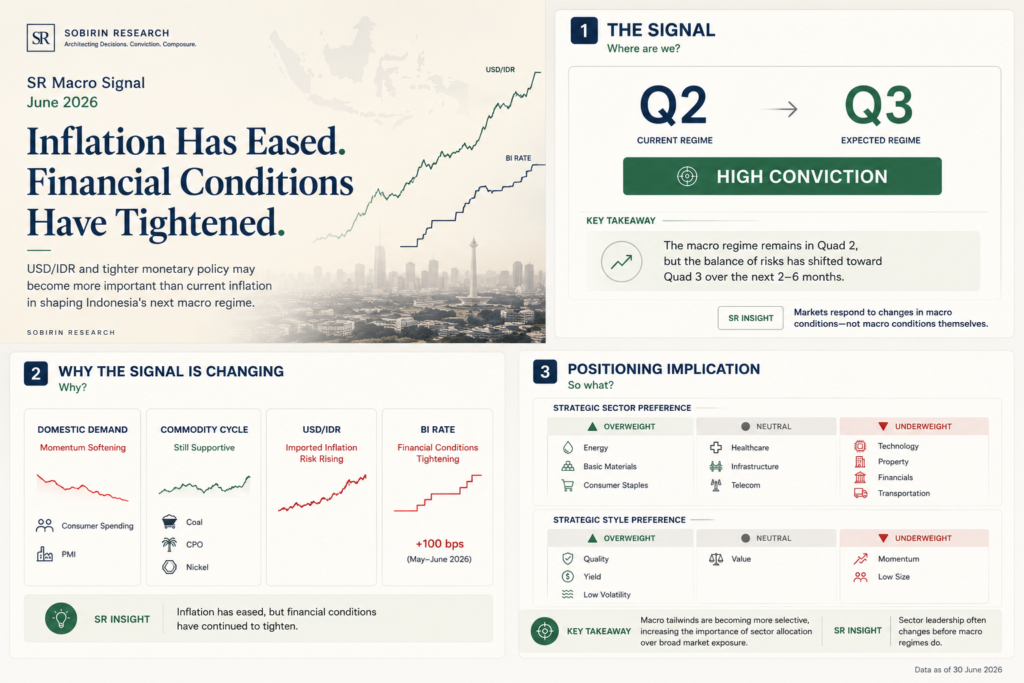
Macro Regime Q2 | Expected Regime Q3 | Conviction High | Data Input 30 June 2026
Reading Time: 5 min
Executive Summary
- Our analysis suggests that Indonesia remains in Quad 2. However, the probability of transitioning toward Quad 3 has increased if current macro trends persist.
- Domestic demand continues to support economic activity, but moderating manufacturing momentum suggests that growth is becoming less broad-based than earlier in the year.
- Persistent USD/IDR weakness raises the risk of imported inflation over the coming months. At the same time, money supply (M2) remains supportive, while Bank Indonesia’s cumulative 100 bps rate hikes indicate a clear commitment to maintaining macro stability.
Our latest reading suggests that growth momentum has softened, while inflation pressures have eased from earlier highs. At the same time, financial conditions have tightened following Bank Indonesia’s cumulative 100 basis points of policy rate increases.
Although inflation has moderated, one variable deserves closer attention.
USD/IDR has remained under sustained depreciation pressure, making it one of the most important indicators to monitor over the coming months. Exchange rate movements typically transmit into imported prices with a lag, implying that future inflation risks should not be assessed solely from current CPI readings.
Rather than signalling a broad deterioration of the economy, the current environment points to a changing macro regime, where sector performance is likely to become increasingly differentiated.
What Changed?
Several macro indicators experienced meaningful changes over the past twelve months.
- Consumer Spending Score moderated from earlier strength.
- Manufacturing PMI weakened, reflecting softer business activity.
- Commodity Composite (Coal, CPO and Nickel) remained supportive but no longer accelerated at the previous pace.
- Inflation eased after peaking earlier this year.
- USD/IDR experienced significant depreciation, becoming one of the key macro variables to monitor.
- Money Supply (M2) continued expanding.
- Bank Indonesia tightened monetary policy through cumulative 100 bps rate hikes.
Taken together, these developments suggest that macro conditions are becoming more balanced but also more selective than earlier phases of the cycle.
The June 2026 SR Macro Model therefore maintains Indonesia in Quad 2, while assigning a High Conviction probability that the macro environment gradually shifts toward Quad 3 over the coming months.
For investors, the implication is straightforward:
The environment is becoming increasingly selective. Portfolio outcomes are likely to depend more on sector and factor allocation than on broad market exposure.
Understanding the Signal
Inflation has eased
Headline inflation has continued to moderate, while core inflation remains relatively stable. This reduces the probability that inflation alone will remain the dominant macro risk over the near term.
Domestic demand has softened
Several indicators suggest that domestic demand is gradually losing momentum. Consumer spending has moderated, while manufacturing activity has become less robust than earlier in the year.
Growth remains positive, but its momentum is becoming less broad-based.
Commodity support remains intact
Indonesia continues to benefit from relatively supportive commodity markets, particularly coal, CPO, and nickel.
These sectors continue to provide an important cushion for exports and corporate earnings, although commodity strength alone may not fully offset tighter domestic financial conditions.
Financial conditions have tightened
This remains the most important change in the current signal.
Two developments stand out:
- Bank Indonesia increased policy rates by 100 bps within two months.
- USD/IDR continued to trend higher, increasing imported inflation risks and tightening domestic liquidity conditions.
Although inflation has moderated, financing conditions across the economy have become more restrictive.
That shift explains why our model now assigns a higher probability to Quad 3.
The Position Implication
Our analysis suggests that market leadership may gradually rotate as macro conditions evolve.
The current signal increasingly favors sectors expected to benefit from stronger macro tailwinds should Indonesia move toward Quad 3. Conversely, sectors that rely heavily on accelerating domestic growth or abundant liquidity may face a less supportive backdrop if current trends persist.
Our Strategic Sector Preference and Strategic Style Factor Preference summarize this forward-looking assessment. They are intended to narrow the investment universe, while security selection remains driven by bottom-up fundamental research.
For a complete description of the methodology behind the SR Macro Model, please refer to the – SR Macro Model Methodology.