

Macro Regime: Q2 | Expected Regime: Q3 | Conviction: High | Data as of: 1 July 2026
Reading time : 5 mins
Executive Summary
- Indonesia remains in Quad 2, but June’s data materially strengthened the case for a transition toward Quad 3. Growth weakened, inflation re-accelerated, and financial conditions tightened
- As macro conditions become more selective, our research increasingly favors Quality, Yield, and Low Volatility over Momentum and Low Size
- For July 2026, our research will focus on Consumer Staples, Institutional-Grade Financials, and Energy
The Signal
What Changed?
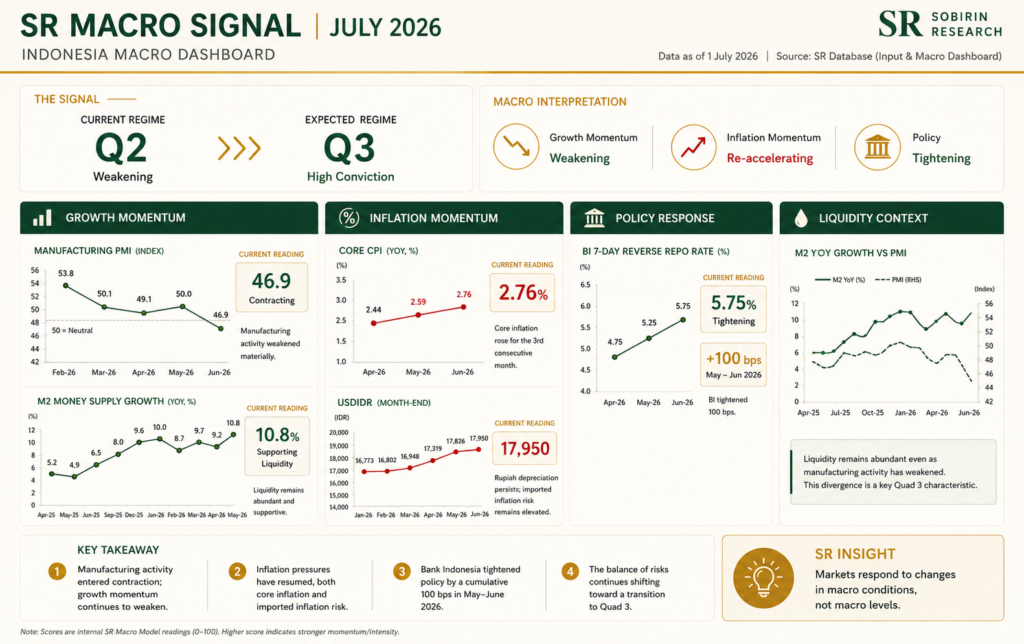
June’s macro releases pointed in a remarkably consistent direction.
Growth momentum weakened further as manufacturing activity fell back into contraction, with the Manufacturing PMI declining to 46.9, its lowest reading in more than a year. Although liquidity conditions remain supported by relatively strong money supply growth, business activity has yet to respond accordingly.
Inflation, meanwhile, continued moving higher. Core inflation has risen for three consecutive months, while continued Rupiah depreciation increases the risk of imported inflation feeding into domestic prices with a lag.
Bank Indonesia responded by extending its tightening cycle, bringing cumulative policy rate increases to 100 basis points over May and June. Financial conditions therefore continue to tighten despite inflation remaining well below its earlier peak.
Taken together, these developments do not yet suggest that Indonesia has entered Quad 3. They do, however, strengthen the probability that the current Quad 2 environment is becoming progressively less supportive for broad-based equity leadership.
Research Priorities
Preferred Style
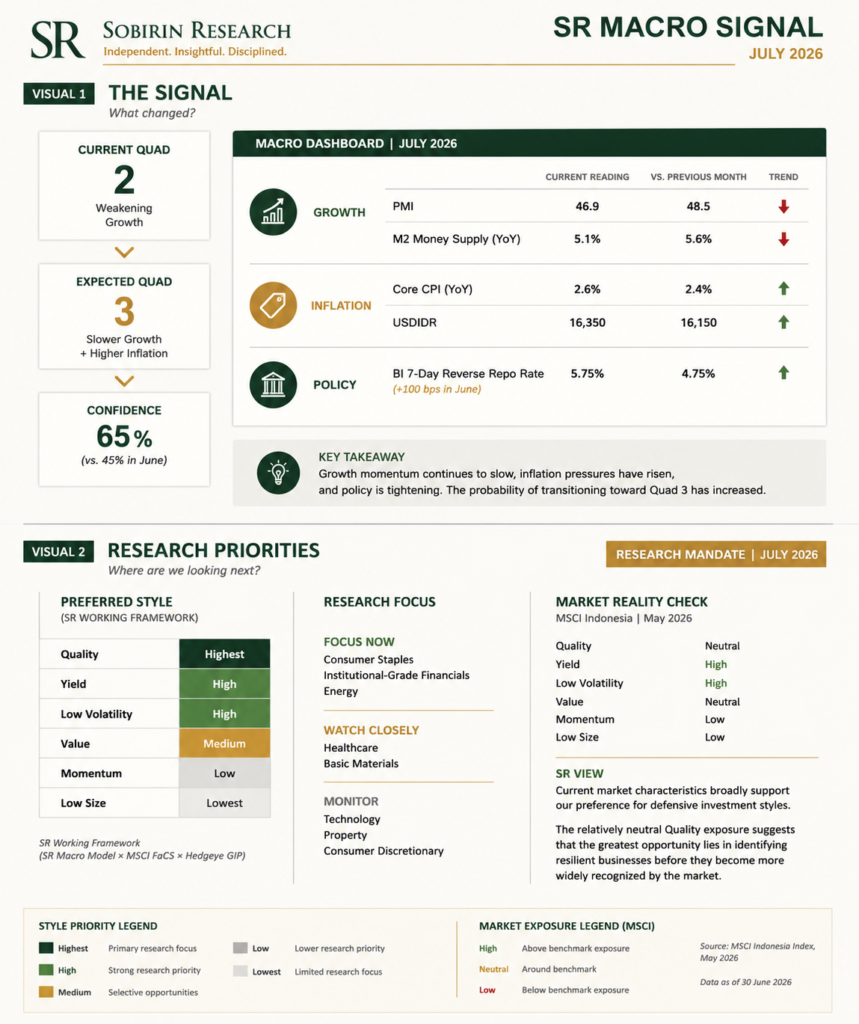
The current macro environment increasingly favors business quality over market beta.
As growth momentum softens and financial conditions tighten, our working framework shifts its research priority toward Quality, followed by Yield and Low Volatility. These characteristics have historically demonstrated greater resilience during periods when earnings dispersion increases and macro conditions become less supportive for cyclical leadership.
Value remains relevant, although opportunities are becoming increasingly company-specific rather than market-wide. By contrast, Momentum and Low Size become lower priorities as liquidity conditions tighten and investor risk appetite becomes more selective.
Our objective is not to forecast short-term factor performance. Instead, these preferences serve as a practical framework for allocating our research effort.
Research Focus
Preferred styles naturally shape our bottom-up research priorities.
For July 2026, our primary research effort will focus on Consumer Staples, Institutional-Grade Financials, and Energy.
Consumer Staples offer relatively resilient demand characteristics during periods of slowing growth. Energy continues to generate attractive cash flows despite recent commodity price volatility. Meanwhile, Indonesia’s largest banks remain central to both domestic and foreign institutional portfolios due to their liquidity, benchmark weight, and systemic importance within the Indonesian equity market.
We also continue to monitor Healthcare, Basic Materials, and Infrastructure. While Infrastructure is not currently a primary research focus, its Utilities sub-sector has historically demonstrated defensive characteristics. This broadly aligns with Hedgeye’s historical sector preference during Quad 3, making selected Infrastructure companies worthy of closer observation as macro conditions evolve.
Gold-related Companies : Historically, gold has outperformed during Quad 3 environments. We are expanding our research coverage to selected Indonesian companies with meaningful gold exposure.
Selected Utilities: Utilities have historically demonstrated defensive characteristics during Quad 3. Selected companies within Indonesia’s Infrastructure sector warrant closer attention.
Technology, Property, Consumer Discretionary, Industrials, and Transportation & Logistics remain on our monitoring list as additional macro data become available.
Market Reality Check
The latest MSCI Indonesia Factor Exposure (May 2026) provides an independent perspective on how the market is currently positioned.
Indonesian equities remain relatively tilted toward Yield and Low Volatility, while Quality remains broadly neutral. This broadly aligns with our increasingly defensive macro assessment, This broadly aligns with our increasingly defensive macro assessment, while the relatively neutral Quality exposure suggests further scope for differentiated bottom-up research.
Rather than treating MSCI’s factor exposures as investment recommendations, we view them as an external benchmark against which we continuously evaluate and challenge our own research framework.
Macro signals rarely identify tomorrow’s winners.
They help narrow an increasingly large investment universe into a smaller group of businesses that deserve closer attention.
Our current assessment therefore shifts our research toward companies combining resilient business quality, durable cash generation, institutional relevance, and attractive long-term economics.
The coming releases of Q2 demand-side data—including household consumption and gross fixed capital formation—will determine whether the current transition toward Quad 3 is confirmed or challenged. Until then, our research remains focused not on predicting markets, but on improving the probability of identifying exceptional businesses before they become broadly recognized by the market.