
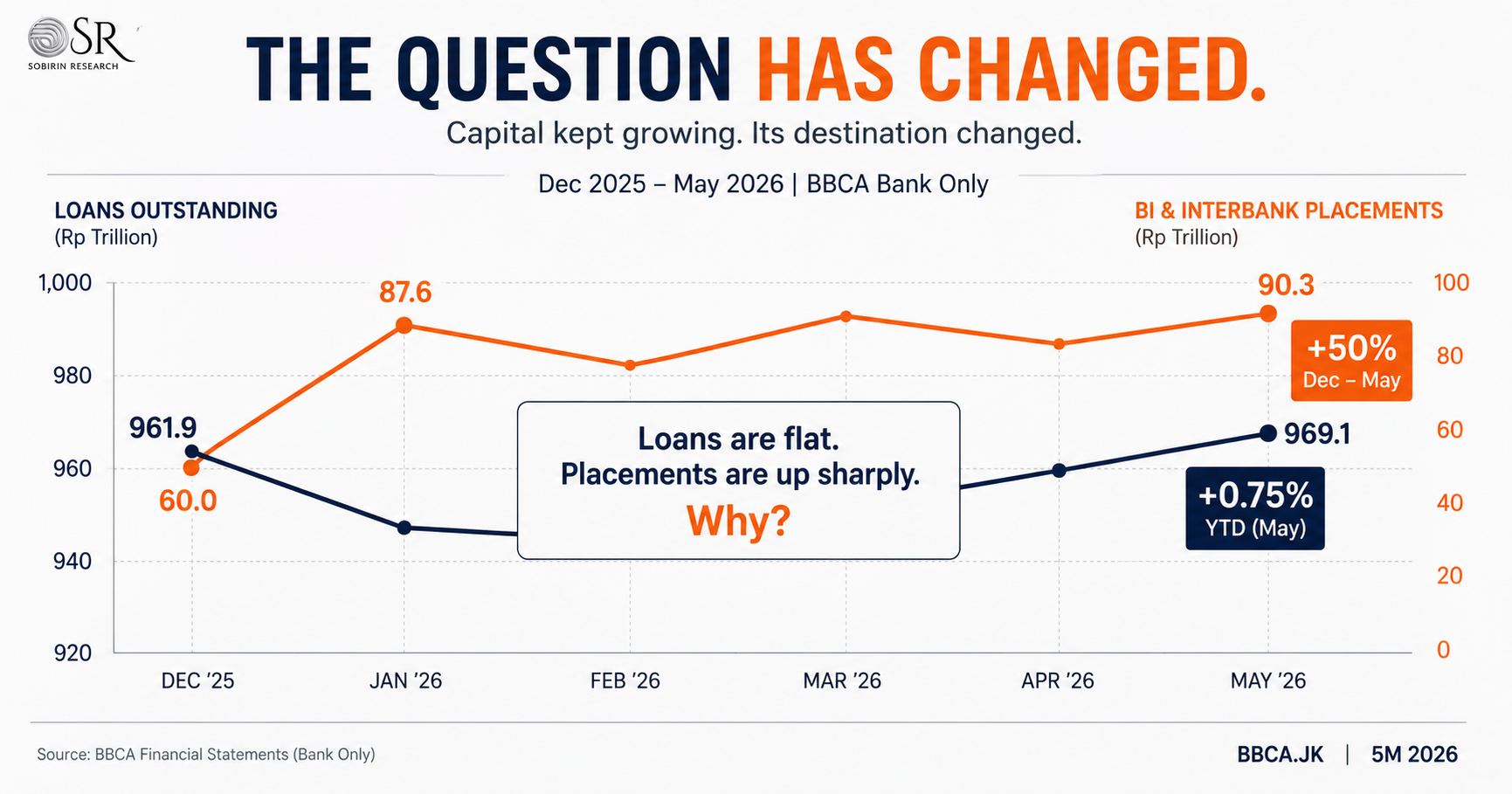
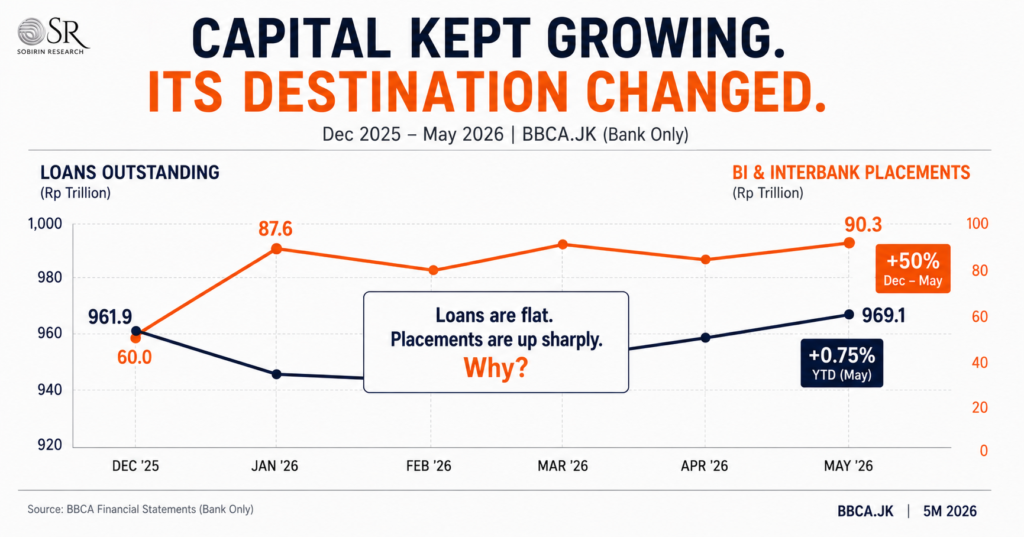
BBCA’s loans grew just 0.75% this year. Its placements at Bank Indonesia and other banks grew 50% in the same five months.
That is not a typo, and it is not a coincidence. It is the single fact that this report was written to explain.
For years, investors have asked the same question about PT Bank Central Asia Tbk: can it continue generating exceptional returns?
We believe that is no longer the right question.
The business is not the problem.
The investment question has changed.
Taken at face value, flat loans and surging placements look contradictory. A bank that isn’t lending should be a bank under stress. But the balance sheet does not suggest financial stress. It suggests abundant capital searching for productive opportunities.
That distinction is precisely why this report exists.
A great business does not automatically remain a great investment. The defining question is no longer whether BBCA can generate capital — it clearly still can — but whether it can continue allocating that capital at extraordinary rates.
The slowdown was less linear than the headline suggests.
Loan growth did not gradually weaken through early 2026. It first contracted. Outstanding loans declined from Rp961.9 trillion at year-end 2025 to Rp949.0 trillion in January, before recovering for four consecutive months — expanding roughly 2.1% through May, equivalent to an annualized pace closer to BBCA’s historical range than the flat year-to-date figure alone would suggest.
What happened next is the more revealing part.
If the excess liquidity from January had simply been capital waiting to be deployed into loans, interbank and Bank Indonesia placements should have started declining once lending resumed. They did not. Placements surged to almost Rp88 trillion in January — the very month loans contracted — and remained elevated in the Rp78–91 trillion range through May, despite four consecutive months of loan growth.
This is not simple substitution between two uses of capital. It is simultaneous balance-sheet expansion. Capital is still being created. What’s changed is management’s apparent willingness to preserve optionality rather than deploy at full pace.
Meanwhile, the payout ratio is quietly doing something structural. BBCA’s dividend payout ratio reached 71.99% in FY25, up from 67.4% in FY24 and well above the 64.7% five-year median our model uses for retention. DPS grew 12.0%, against EPS growth of just 4.9% — dividends compounding roughly 2.4x faster than earnings. That directly shrinks the capital available for reinvestment, the single input BBCA’s long-term compounding engine depends on most.
Recent sell-side commentary — including JPMorgan’s downgrade of BBCA earlier this year — suggests the market has become increasingly focused on margins and capital deployment. Our approach begins somewhere else: instead of forecasting the next earnings surprise, we ask whether extraordinary profitability can continue to be reinvested at extraordinary rates.
None of this points to a weaker franchise.
CASA ratio sits at 85.1%, up from 79.0% in 2021, without BBCA paying up for it. Credit cost is 0.30%, near the low end of its five-year range. Economic profit — ROE minus cost of equity — stands at +12.8 percentage points, near a multi-year high. By every measure of business quality, BBCA is performing as well as it ever has.
Indonesia’s macro backdrop has become more selective over the same period — growth momentum has weakened, financial conditions have tightened, and equity valuations have broadly de-rated. None of that shows up in BBCA’s own numbers.
The tension sits one layer downstream, in the link between profitability and reinvestment — the part of the compounding engine that has quietly become harder to observe from the outside, and the part that ultimately decides whether today’s returns are a plateau or a peak.
When capital is no longer scarce, can exceptional capital allocation remain exceptional?
A Structural Tailwind, Not an Investment Thesis
For any portfolio benchmarked to Indonesia, BBCA is difficult to avoid. Recent debate around the country’s position within MSCI’s benchmark indexes has been a reminder of why: BBCA’s weight in the MSCI Indonesia Index alone makes it central to how passive and benchmark-aware capital flows into the market. That structural demand may help explain part of the bank’s persistent valuation premium. It does not answer a different, and ultimately more important, question.
What return is today’s market already asking investors to accept?
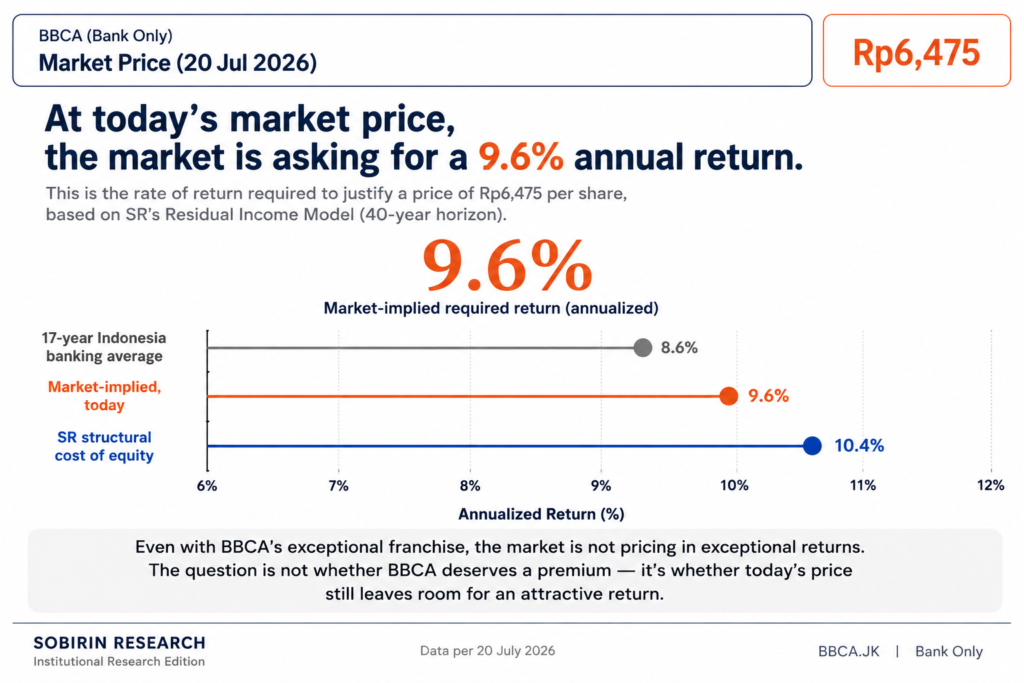
The market isn’t pricing BBCA as if nothing has changed. It’s pricing it somewhere between historical caution and our own structural estimate — which raises a different question than “is this cheap”: is the market underestimating how durable BBCA’s reinvestment engine still is, or has it already quietly adjusted?
That gap is small, but it is not nothing. And it says more about how the market is currently thinking about BBCA than any single earnings print would.
That framework rests on one assumption above all others: how long BBCA’s returns stay this high. So we built one more test.
BBCA’s own ROE has ranged from 15.3% to 22.5% since 2019, and sits at 21.8% today — a history that, on its own, doesn’t rule out 13% or 15% as achievable. So we went looking for evidence outside BBCA’s own numbers: how other dominant, low-cost-funded banking franchises have behaved over comparable stretches of time.
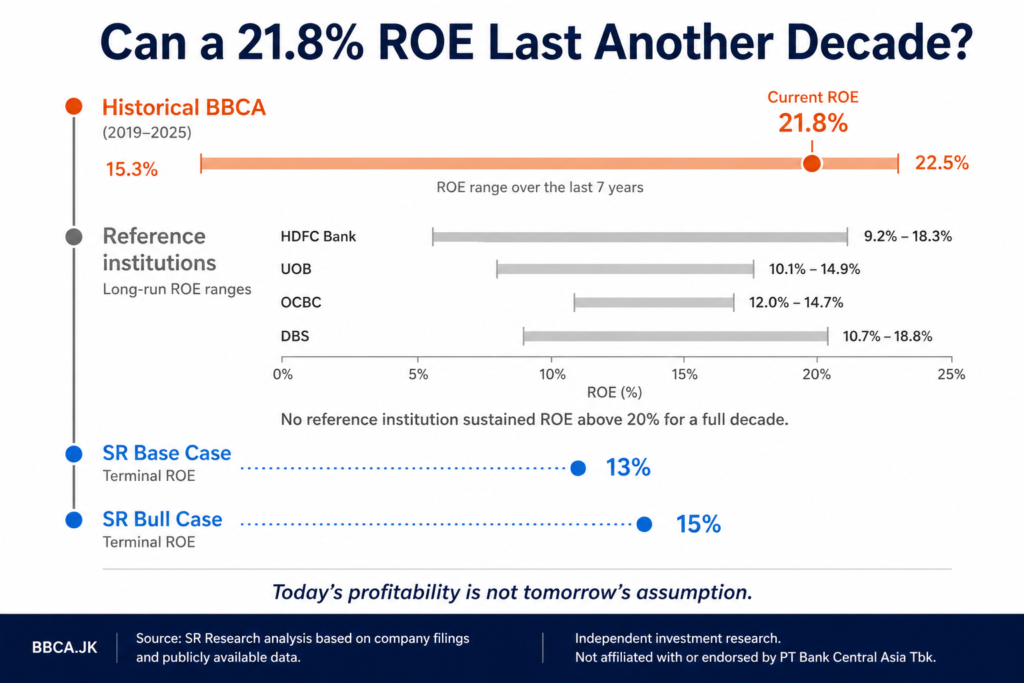
No reference institution sustained a return on equity above 20% for a full decade. That doesn’t mean BBCA can’t be the exception. It means our Base Case doesn’t assume it has to be.
Three facts, three different questions: where the capital is going, what return the market is already demanding, and whether history allows for the ROE our valuation assumes. Our full research puts all three inside one framework — reconstructing BBCA’s incremental capital month by month since December 2025, and valuing the business through a Residual Income model anchored to a through-cycle cost of equity, rather than to today’s market sentiment.
The next earnings release may answer whether recent liquidity patterns persist. It will not answer the larger question this report explores: can exceptional capital allocation remain exceptional?
SR Research: BBCA — The Durability of Capital Compounding – July 2026
Institutional Research Edition | July 2026
- ✓ 19-page institutional research report
- ✓ Original investment thesis
- ✓ Intrinsic value using our Residual Income Model
- ✓ Research diagnostics & valuation appendix
Available for FREE